Kriterio ni Kelly ken ti Ruleta
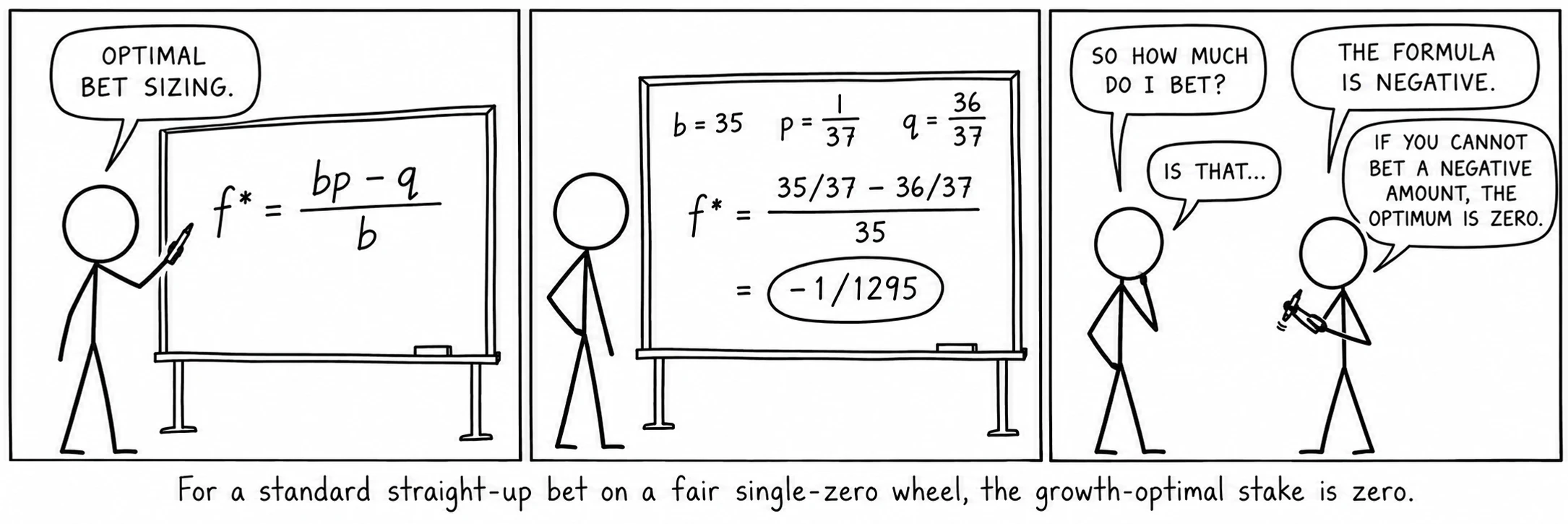
Ti Kelly criterion ket ibagana iti agpusta nga addaan iti bentaha no mano ti rumbeng nga ipustana. Para iti ruleta, nalawag ti sungbatna: awan.

Pusta ti Kelly = bentaha / tsansa. No negatibo ti bentaha, negatibo a paset ti isubli ti pormula, a kayatna a sawen: dikay agpusta. Makatulong latta ti criterion tapno maawatan no apay a kasta ti kadakkel ti pusta dagiti agay-ayam a nangbirok iti panagkillo ti pilid, ken no apay a rumbeng a ti badyet ti pangibasaran ti kadakkel ti pusta ti amin a sabsabali.
Ti criterion
John Kelly (1956) asked how a gambler with a known edge should size bets to maximize long-run growth of the bankrollkuartaPondo ti ay-ayamTi dagup a kuarta a naisina para iti ay-ayam. Ti panangimaton iti pondo ti ay-ayam ket panangikeddeng no mano ti mabalin nga ipeggad iti tunggal pusta ken iti tunggal sesion.Basaen amin →. The answer, for a bet paying b to 1 with win probabilitymatematikaProbabilidadTsansa ti maysa a resulta, manipud iti 0 agingga iti 1 wenno 0% agingga iti 100%. Maysa a numero: 1/37 = 2.70%.Basaen amin → p and loss probability q = 1 − p, is to stake the fraction f* = (bp − q) / b of the bankroll. Positive f* means bet that fraction; zero or negative means do not bet. Kelly worked at Bell Labs, and his paper, “A new interpretation of information rate”, set the problem in Claude Shannon’s theory of information: a gambler who gets tips over a noisy line, at fair odds, can grow the bankroll at best at the rate the line carries information. This is a growth objective under a probability model, not a promise to finish ahead after a particular number of bets. A spending limit, finite deadline or payoutkuartaBayadTi isubli ti nangabak a pusta, maibaga a kas “X iti 1” a nainayon iti naisubli a pusta.Basaen amin → cap changes the decision problem.

Panagpusta a Kelly iti ruleta
For redpustaNalabagaPusta a pantay ti bayad iti 18 a nalabaga a numero. Iti Pranses: rouge.Basaen amin →: b = 1, p = 18/37, q = 19/37; f* = (18/37 − 19/37)/1 = −1/37. For a straight uppustaMaysa a numeroMaymaysa a numero, agbayad iti 35:1.Basaen amin →: b = 35, p = 1/37, q = 36/37; f* = (35/37 − 36/37)/35 = −1/1295. Every standard bet gives a negative Kelly fraction, because every bet has a negative edge, and the growth-optimal stake is zero. Kelly betting on roulette is a formal way of saying what the house-edge page says: no positive stake maximizes expected logarithmic growth when the bet has negative expectation. A particular session can still end in profit. La partagepagannurotanLa partagePranses a pagannurotan: no rummuar ti sero, maisubli ti kagudua ti pusta a pantay ti bayad. Kagudua ti bentaha ti kasino kadagidiay a pusta, agingga iti 1.35%.Basaen amin → needs a separate three-outcome calculation: a win, a full loss or a half-loss on zeropilidSeroTi maymaysa a berde a bulsa a saan a saklawen ti aniaman a pusta a pantay ti bayad, dosena wenno kolum; ti nagtaudan ti bentaha ti kasino. Maawagan met iti maymaysa a sero, 0.Basaen amin →. Its expected log growth also falls as the stake increases from zero.
No sadino ti pakaiyaplikaran ti Kelly
Suppose a pocketalikamenBulsaMaysa kadagiti 37 a nanumeruan a kompartimento iti rotor. Maawagan met iti slot, cup.Basaen amin → really has a stable, known probability of 1 in 30 and pays 35 to 1. The Kelly fraction is 0.57%: about $57 from a $10,000 bankroll. Under independent spinsmatematikaAgsisina a tayyekTunggal tayyek ket addaan iti isu met laeng a probabilidad aniaman ti napalabas. Ti pundasion ti tunggal pannakakuenta iti daytoy a site.Basaen amin → and exact fractional staking, the geometric growth factor over 1,000 spins is about 1.7. Expected bankroll grows faster because rare large wins pull up the average. These are model calculations, not evidence that any named historical player used Kelly or achieved this result.
Kadawyan ken promedio
The gap between the typical bankroll and the average one is wide. Take a pocket that hits 1 time in 25, a hypothetical edge of 44% per unitkuartaYunitTi base a pusta a pagtrabahuan ti maysa a sistema wenno agay-ayam. Dagiti progresion ket maiyladawan iti yunit tapno agaplikarda iti aniaman a lamisaan.Basaen amin → staked. Kelly stakes 1.26% of the bankroll on it. After 1,000 spins the typical bankroll has grown about 11.5 times, while the average, pulled up by a few very lucky runs, has grown about 249 times. Betting more than Kelly raises the average and lowers the typical result: at twice the Kelly stake the typical bankroll only doubles, and by two and a half times the Kelly stake it shrinks, although every bet still carries a 44% edge. In this example, half-Kelly retains about 78% of the expected log growth. This fraction depends on the probabilities and payout.
No pattapatta laeng ti bentaha
Kelly uses the true probabilities, but a player usually has only estimates. Selecting the busiest pocket from a past record creates a selection problem: even a fair wheel has a busiest pocket. Its observed rate can overstate its future probability. Choosing the stake from that same record compounds the error. An independent follow-up sample helps test a proposed bias (see How to Detect Roulette Wheel Bias). Reducing the calculated fraction reduces exposure, but cannot turn a false edge into a real one.
Dagiti tao nga addaan iti bentaha
Haghani and Dewey (2016) studied 61 participants given $25 and 30 minutes to bet on a simulated coin with a disclosed 60% chance of heads. The payout cap was $250; its value was revealed when a proposed winning bet would reach it. Their reported 21% success category included balances of at least $200, while the 28% “bust” category meant less than $2, not necessarily zero. Eighteen participants bet their entire balance on one flip. The uncapped Kelly fraction is 20%, but the cap and deadline change the optimization problem. The experiment illustrates how stake choices matter even with a known advantage; it does not establish one best strategy for every objective.
Ania ti usaren imbes
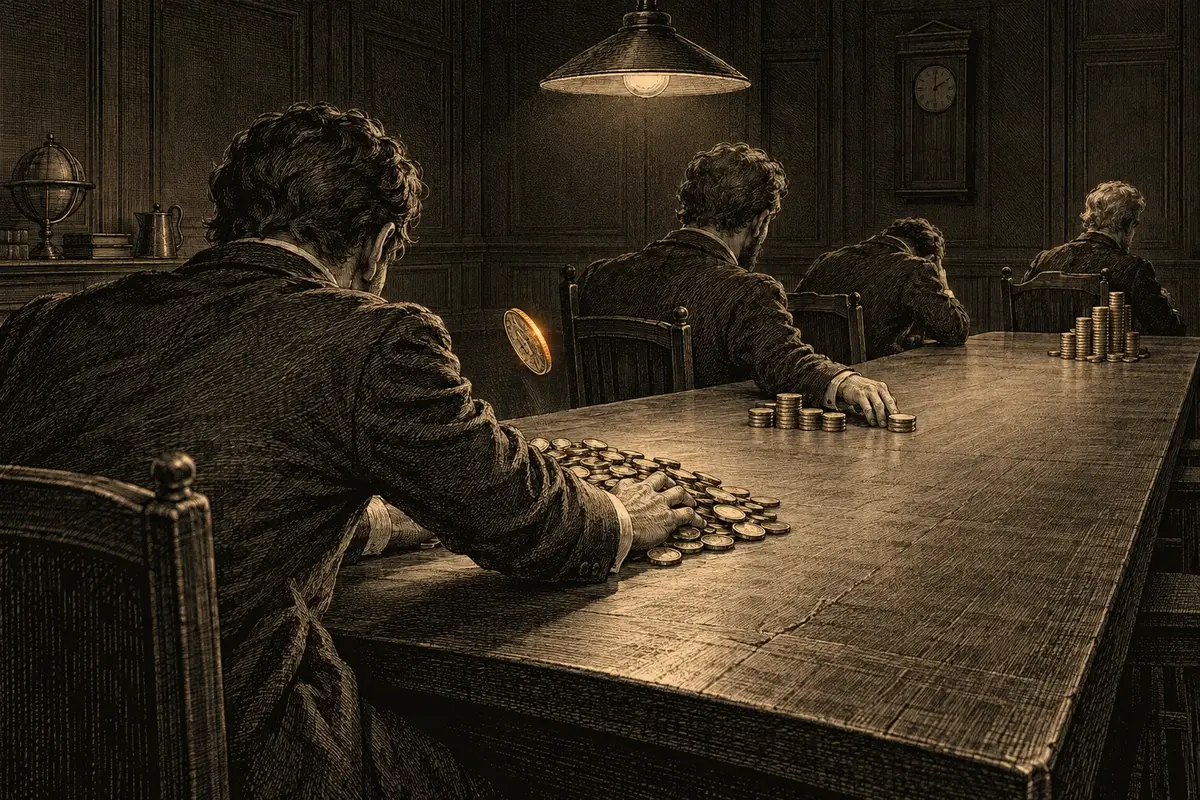
No awan ti bentaha, ti kadakkel ti pusta ket saludsod ti badyet, saan a saludsod ti panagdakkel: pusta = ti kayatyo a gastuen iti tunggal tayyek, a nagtaud iti badyet iti tunggal oras ken iti kapardas ti lamisaan (panid ti panangimaton iti pondo ti ay-ayam). Ti maited ti Kelly iti kadawyan nga agay-ayam ket ti kinalawag ti sungbatna: sero. Amin nga ipustayo iti ngato ti sero ket presio ti panagay-ayam, a pinilienyo, saan nga in-optimize ti aniaman a pormula.
Maysa a nota maipapan iti paset ti Kelly ken “money management”
Betting a fixed percentage of the current bankroll is proportional staking: the stake rises after wins and falls after losses. Flat bettingestratehiaAgpada a pustaPanangipusta iti isu met laeng a kantidad iti tunggal tayyek. Ti pagrukodan a pangidiligan iti tunggal progresion.Basaen amin → instead keeps the cash stake fixed. Neither creates an edge on ordinary roulette. With infinitely divisible stakes and a fraction below 100%, proportional staking never reaches exactly zero in finitely many losses, but the balance can become arbitrarily small. Real table minimums can prevent further play much sooner. The growth-optimal fraction remains zero.
Pormula
Dagiti Saludsod
Only when the actual probabilities, payouts and conditions give a credible positive advantage. Standard bets on an unbiased wheel have no such advantage.
Using half the calculated fraction reduces exposure to errors in the estimated edge. The familiar three-quarters-growth rule is an approximation for small advantages, not a universal identity. It does not protect against an edge that does not exist.
Saan. Ti Kelly ket i-optimize ti panagdakkel no adda bentaha. Ti panangimaton iti pondo ket kontrolenna ti panaggastos no awan.
Naragsak a Matematika
Padasenyo pay nga umuna dagitoy. Nailemmeng ti tunggal solusion; lukatanyo no nakasaganakayon.
Suppose a hypothetical bet on one number has a known 44% edge under standard payoutskuartaBayadTi isubli ti nangabak a pusta, maibaga a kas “X iti 1” a nainayon iti naisubli a pusta.Basaen amin → and independent spinsmatematikaAgsisina a tayyekTunggal tayyek ket addaan iti isu met laeng a probabilidad aniaman ti napalabas. Ti pundasion ti tunggal pannakakuenta iti daytoy a site.Basaen amin →. Kelly gives a 1.26% bankrollkuartaPondo ti ay-ayamTi dagup a kuarta a naisina para iti ay-ayam. Ti panangimaton iti pondo ti ay-ayam ket panangikeddeng no mano ti mabalin nga ipeggad iti tunggal pusta ken iti tunggal sesion.Basaen amin → fraction. What if the same 44% edge came on one bet spread over five neighboring numbers?
Ipakita ti solusion
Sungbat Kalpasanna ibaga ni Kelly ti 7.1% ti pondo ti ay-ayam, ken dumakkel ti pondo iti dandani mamin-innem a kapardas: agarup 1.25 a milion a daras iti 1,000 a pusta, maibusor iti agarup 11.5 a daras.
A straight uppustaMaysa a numeroMaymaysa a numero, agbayad iti 35:1.Basaen amin → with a 44% edge wins with chance 0.04, since 36 × 0.04 = 1.44. Kelly’s stake is the edge divided by the odds: 0.44/35 = 1.26%. The typical growth per bet is 0.04 × ln(1 + 35 × 0.0126) + 0.96 × ln(1 − 0.0126) ≈ 0.00244, so 1,000 bets multiply the bankroll by about e^2.44 ≈ 11.5.
Spread one stake over five numbers and the bet wins with chance 0.20 and pays 36/5 for 1, that is 6.2 to 1: still a 44% edge, since 0.2 × 7.2 = 1.44. Kelly’s stake becomes 0.44/6.2 = 7.10%, and the growth per bet 0.01404, about 5.75 times as much. Over 1,000 bets that is e^14.04, about 1.25 million.
The edge is the same; the swings are smaller. A bet that wins one time in five has a larger growth-optimal fraction in this model, although losses can still reduce the bankroll severely. This comparison assumes the same known edge for both bets; actual predictions need independent evidence.
Assume two numbers are adjacent on the betting layoutalikamenPlano ti lamisaanTi naimaldit a grid ti panagpusta iti lamisaan. Maawagan met iti lamisaan, felt, lupot.Basaen amin → and each has a stable, known probabilitymatematikaProbabilidadTsansa ti maysa a resulta, manipud iti 0 agingga iti 1 wenno 0% agingga iti 100%. Maysa a numero: 1/37 = 2.70%.Basaen amin → of 1 in 25 on independent spins. Compare a splitpustaDua a numeroDua nga agsinnaruno a numero, agbayad iti 17:1.Basaen amin → between them at 17 to 1 with equal straight-up stakes on the two numbers. How much does Kelly say, and how fast does the bankroll grow compared with one such pocketalikamenBulsaMaysa kadagiti 37 a nanumeruan a kompartimento iti rotor. Maawagan met iti slot, cup.Basaen amin →?
Ipakita ti solusion
Sungbat Awan ti nagdumaanna: 2.59% ti pondo ti ay-ayam iti dua a numero, wenno 1.29% iti tunggal numero. Ti gagangay a pondo ti ay-ayam ket dumakkel iti agarup 155 a daras iti 1,000 a tayyek, maibusor iti 11.5 a daras iti maymaysa a bulsa.
The split wins with probability 2/25 = 0.08 and pays 17 to 1, so it returns 18 × 0.08 = 1.44 per unitkuartaYunitTi base a pusta a pagtrabahuan ti maysa a sistema wenno agay-ayam. Dagiti progresion ket maiyladawan iti yunit tapno agaplikarda iti aniaman a lamisaan.Basaen amin → staked: an edge of 44%, the same as one biased pocket. Kelly’s stake is the edge divided by the odds: 0.44/17 = 2.59%.
Two straight-up bets of 1.29% each give exactly the same results. When either number comes up, one chipkuartaTsipMarka a mangibagi iti naikeddeng a kantidad, maikabil iti plano ti lamisaan tapno makaaramid iti pusta. Maawagan met iti check.Basaen amin → wins 35 to 1 and the other is lost, a net of 34 × 1.29% = 44% of the bankroll, as the split pays; when neither does, both are lost.
The growth per spin is 0.00505, against 0.00244 for one pocket, so over 1,000 spins the typical bankroll grows e^5.046 ≈ 155 times rather than e^2.44 ≈ 11.5 times. The geometric growth factor is larger because the combined bet wins more often at the same 44% edge. It is a model result, not a guaranteed bankroll.
Pagkatawaan
Ti pusta iti ruleta a mangted iti kasayaatan a panagdakkel ket numero nga ammo itan ti amin.
Dagiti Taudan
- Kelly, J. L. “A new interpretation of information rate.”
- Breiman, L. “Optimal gambling systems for favorable games.”
- Thorp, E. O. “Optimal gambling systems for favorable games.”
- Thorp, E. O. The Mathematics of Gambling.
- Epstein, R. A. The Theory of Gambling and Statistical Logic, 2nd ed.
- Taylor, D. G. Games, Gambling, and Probability: An Introduction to Mathematics, 2nd ed.
- Ethier, S. N. The Doctrine of Chances: Probabilistic Aspects of Gambling.
- Haghani, V. & Dewey, R. “Rational decision-making under uncertainty: observed betting patterns on a biased coin.”