Parikut: Ti Limitasion ti Lamisaan
Martingale iti $10 iti lamisaan nga addaan iti $500 a limitasion. Kasano ti kadalas ti pannakaburakna, mano ti mapukaw no mapasamak dayta, ken makatulong kadi ti panangpangato iti limitasion?
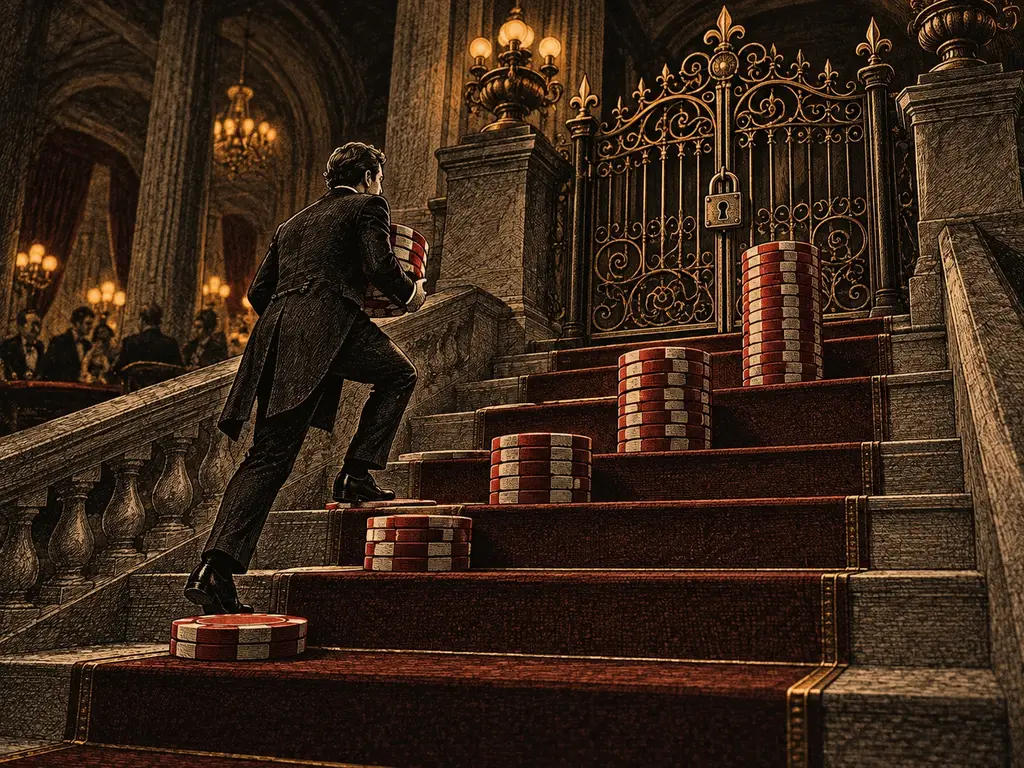
Innem a sagsaganad a pukaw ti mangburak iti dayta: 1.8% iti tunggal siklo, agarup 60% dagiti sesion a 100 a tayyek. Ti pannakaburak ket $630 ti gastosna. Ti panangpangato iti limitasion iti $5,000 ket pagbalinenna a manmano ti pannakaburak (0.25% iti tunggal siklo) ken dakdakkel ($5,110). Ti mapadpadles a pukaw iti tunggal doliar a naipusta ket 2.70% iti aniaman a limitasion.
Ti parikut
Assume independent spinsmatematikaAgsisina a tayyekTunggal tayyek ket addaan iti isu met laeng a probabilidad aniaman ti napalabas. Ti pundasion ti tunggal pannakakuenta iti daytoy a site.Basaen amin → and standard single-zeropilidSeroTi maymaysa a berde a bulsa a saan a saklawen ti aniaman a pusta a pantay ti bayad, dosena wenno kolum; ti nagtaudan ti bentaha ti kasino. Maawagan met iti maymaysa a sero, 0.Basaen amin → payoutskuartaBayadTi isubli ti nangabak a pusta, maibaga a kas “X iti 1” a nainayon iti naisubli a pusta.Basaen amin →, with enough bankrollkuartaPondo ti ay-ayamTi dagup a kuarta a naisina para iti ay-ayam. Ti panangimaton iti pondo ti ay-ayam ket panangikeddeng no mano ti mabalin nga ipeggad iti tunggal pusta ken iti tunggal sesion.Basaen amin → to fund each permitted stake. A player bets $10 on redpustaNalabagaPusta a pantay ti bayad iti 18 a nalabaga a numero. Iti Pranses: rouge.Basaen amin → and doubles after each loss, resetting after a win. The table maximum is $500. (a) How many consecutive losses break the progressionestratehiaProgresionAniaman a pagannurotan a mangbaliw iti pusta sigun kadagiti napalabas a resulta. Dagiti negatibo a progresion ket ipangatoda daytoy kalpasan ti pukaw, dagiti positibo kalpasan ti abak.Basaen amin →? (b) What is the probabilitymatematikaProbabilidadTsansa ti maysa a resulta, manipud iti 0 agingga iti 1 wenno 0% agingga iti 100%. Maysa a numero: 1/37 = 2.70%.Basaen amin → per cycle? (c) What is lost at the break? (d) How does a $5,000 limit change the answers? (e) Does any limit make the system profitable?
Dagiti solusion (a)–(c)
Dagiti pusta: 10, 20, 40, 80, 160, 320. Ti maikapito ket 640 > 500, isu a innem a pukaw ti mangburak. (b) p(pukaw) = 19/37 iti nalabaga; (19/37)⁶ = 0.0183, agarup 1.8% iti tunggal siklo. Ti maysa a siklo ket agarup dua a tayyek iti promedio, isu a ti sesion a 100 a tayyek ket addaan iti agarup 50 a siklo ken p(uray maysa a pannakaburak) ≈ 1 − 0.9817⁵⁰ ≈ 60%. (c) 10 + 20 + 40 + 80 + 160 + 320 = $630, a 63 a batayan a yunitkuartaYunitTi base a pusta a pagtrabahuan ti maysa a sistema wenno agay-ayam. Dagiti progresion ket maiyladawan iti yunit tapno agaplikarda iti aniaman a lamisaan.Basaen amin →, maibusor iti $10 a kayat koma a maabak ti siklo.
Solusion (d)
At $5,000: stakes to 2,560 are allowed; the tenth stake, 5,120, is refused. Nine losses break it: (19/37)⁹ ≈ 0.25% per cycle, about 11% of 100-spin sessions. Loss at the break: 10 + 20 + … + 2,560 = $5,110. The player has bought a rarer catastrophe at the price of a larger one. Over many sessions the expected cost of breaks is p × loss ≈ 0.0183 × 630 = $11.5 per cycle at the $500 limit and 0.0025 × 5,110 = $12.8 at $5,000; each is the expected contribution from failed cycles. Subtract the expected profit from successful cycles, $10 × (1 − p), to obtain total expected lossmatematikaMapadpadles a pukawMapadpadles a pateg a napaadu iti dagup ti naipusta; ti promedio a kantidad a mapukaw iti maysa a sesion wenno panawen.Basaen amin → per cycle: about $1.74 and $2.71 respectively.
Solusion (e)
With a finite limit and a well-defined stopping rule, expected loss equals expected turnoverkuartaDagup ti pustaTi dagup a kantidad a naipusta iti maysa a sesion wenno panawen, agraman dagiti naabak a kuarta a naipusta manen. Maawagan met iti handle, action.Basaen amin → divided by 37. Changing the limit can change turnover substantially. For the 100-spin examples below, the player resets to $10 after either a win or a failed progression, and has enough money to place every bet. These are exact model expectations, not a simulation. The imaginary unlimited-bankroll, unlimited-stake MartingaleestratehiaMartingaleProgresion a mangdoble iti pusta kalpasan ti tunggal pukaw. Kitaenyo ti paset ti Estratehia para iti ar-aramidenna ken saanna nga ar-aramiden.Basaen amin → is different: a single cycle eventually wins $10 with probability 1, but its expected turnover is infinite. The finite-expectation identity cannot be applied to that unbounded stopping problem. Real bankrolls and tables cannot implement it.
Dua a pudno a lamisaan
Ti pagarigan ni Thorp ket lamisaan a $1 nga addaan iti kangatuan a $1,000, a sadiay namnamaen ti agay-ayam a mangabak iti $30 para iti pangrabii iti maysa a doliar iti tunggal daras. Dagiti pusta a 1, 2, 4 … 512 ket mangipalubos iti sangapulo a pusta, isu a sangapulo a sagsaganad a pukaw ti mangburak iti progresion: maminsan iti 785 a siklo iti pilid nga Europeo (maminsan iti 613 iti Amerikano), iti gastos a $1,023. Ti tallopulo a siklo ket agballigi amin iti 96.2% ti panawen. Ti sabali a 3.8% ket mapukawan iti agarup $1,000, ket ti promedio a resulta ti rabii ket −$9.17, a eksakto nga 1/37 ti $339 nga ipusta ti tallopulo a siklo iti promedio. Ti lamisaan a $5 nga addaan iti kangatuan a $2,000 ket saan a naiduma: dagiti pusta agingga iti $1,280 ket mangipalubos iti siam a pusta, ket ti pannakaburak ket umay maminsan iti 403 a siklo iti pilid nga Europeo (maminsan iti 323 iti Amerikano) ket $2,555 ti gastosna.

Nabaknang nga agay-ayam
The table maximum is only one constraint. The player may run out of money before reaching it. A simulation must state whether it stops, resets to the base stake or bets the remaining balance when the next double is unaffordable. Those choices change session probabilities, so results from one rule cannot describe every Martingale strategy.
Ti leksion
A higher limit permits rarer but larger failed progressions. It does not remove the negative expectation of each standard bet, and it may increase the amount wagered. Compare the total exposure and stopping rule as well as the chance of a short winning cycle.
Pormula
Dagiti Saludsod
Mapalubosannakayo a makalasat agingga iti nangatngato a limitasion, a sadiay manmano ken dakdakkel ti pannakaburak. Saan nga agbaliw ti mapadpadles a pukaw iti tunggal doliar.
Dagiti pusta 10, 30, 70, 150, 310: madanon ti limitasion a $500 kalpasan ti lima a pukaw, ket $570 ti gastos ti pannakaburak. Isu met laeng a 2.70%.
A maximum limits the payout exposure accepted on a bet. The operator sets the actual limits; their existence does not create roulette’s house edgematematikaBentaha ti kasinoTi paset ti tunggal pusta a taginayonen ti kasino iti promedio: 2.70% iti ruleta nga Europeo.Basaen amin →.
Naragsak a Matematika
Padasenyo pay nga umuna dagitoy. Nailemmeng ti tunggal solusion; lukatanyo no nakasaganakayon.
A MartingaleestratehiaMartingaleProgresion a mangdoble iti pusta kalpasan ti tunggal pukaw. Kitaenyo ti paset ti Estratehia para iti ar-aramidenna ken saanna nga ar-aramiden.Basaen amin → starts at $100 on redpustaNalabagaPusta a pantay ti bayad iti 18 a nalabaga a numero. Iti Pranses: rouge.Basaen amin → and allows itself at most n bets a cycle: after n losses in a row it gives up and starts again. Write the average result of one cycle as a formula in n, and work it out for 5, 6 and 7 bets on a European wheel. Assume independent uniform single-zeropilidSeroTi maymaysa a berde a bulsa a saan a saklawen ti aniaman a pusta a pantay ti bayad, dosena wenno kolum; ti nagtaudan ti bentaha ti kasino. Maawagan met iti maymaysa a sero, 0.Basaen amin → results and sufficient funds for every permitted stake.
Ipakita ti solusion
Sungbat Ti promedio ket 100 × (1 − (38/37)ⁿ): −$14.26 para iti 5 a pusta, −$17.35 para iti 6 ken −$20.52 para iti 7. Ti panangpalubos iti ad-adu a pusta ket mangpadakes iti promedio a siklo, saan a mangpasayaat.
A cycle wins $100 unless all n bets lose, which happens with chance qⁿ, where q = 19/37. When they all lose, the stakes 100, 200 … 100 × 2ⁿ⁻¹ add up to 100 × (2ⁿ − 1). So the average is 100 × (1 − qⁿ) − 100 × (2ⁿ − 1) × qⁿ = 100 × (1 − (2q)ⁿ).
Here 2q = 38/37, a little more than 1, so (2q)ⁿ grows with n and the average falls: n = 5 gives 1.1426 and −$14.26; n = 6 gives 1.1735 and −$17.35; n = 7 gives 1.2052 and −$20.52. A longer ladder loses less often, in 3.6%, 1.8% and 0.9% of cycles, but each loss is twice as large, and more money crosses the table each cycle, at 2.70% of every bet.
On an American wheel 2q = 40/38 and the figures are −$29.24, −$36.04 and −$43.20. In a game with no zero 2q = 1, and every cycle averages exactly zero however long the ladder.
Ti “dakkel a Martingale” ket mangdoble iti pusta kalpasan ti pukaw ken mangnayon iti maysa a yunitkuartaYunitTi base a pusta a pagtrabahuan ti maysa a sistema wenno agay-ayam. Dagiti progresion ket maiyladawan iti yunit tapno agaplikarda iti aniaman a lamisaan.Basaen amin →, isu a dagiti pusta ket 1, 3, 7, 15, 31 … Mano ti ganansiayo no ti umuna nga abak ket umay iti maika-1, maika-2, maika-3 wenno maika-k a pusta? Iti $10 a yunit ken $500 a kangatuan, kasano kadalas a madadael ti siklo, ken mano ti balor ti maysa a siklo iti promedio?
Ipakita ti solusion
Sungbat Ti abak iti maika-k a pusta ket mangibati kadakayo iti k a yunit a ganansia: +1, +2, +3 ken dadduma pay. Iti $10 ken $500, madadael ti siklo kalpasan ti lima a pukaw, 3.57% dagiti siklo, para iti −$570. Iti promedio, ti maysa a siklo ket mapukawan iti $2.32 iti $85.73 a naipusta: 2.70%.
The kth stake is 2ᵏ − 1 units: 1, 3, 7, 15, 31. The first k − 1 stakes add up to 2ᵏ − 2 − (k − 1) = 2ᵏ − k − 1. A win on the kth bet pays 2ᵏ − 1, so the cycle ends (2ᵏ − 1) − (2ᵏ − k − 1) = k units up: one extra unit for every loss before the win.
At least $570 is needed to fund all five stakes in a fresh cycle. At $10 a unit the stakes are $10, $30, $70, $150 and $310; the next, $630, is over the $500 maximum. Five losses in a row, (19/37)⁵ = 3.57%, cost 10 + 30 + 70 + 150 + 310 = $570.
Average: the wins bring in $10 × k with chance (19/37)ᵏ⁻¹ × 18/37 for k = 1 to 5, and the break takes $570 with chance 3.57%; together −$2.32. The money staked averages $85.73 a cycle, and 2.32/85.73 = 2.70%. The ordinary Martingale at the same table breaks after six losses, 1.83% of cycles, for −$630, and loses $1.74 out of $64.20 staked: 2.70% again.
Plano ti maysa nga agay-ayam ti Martingale iti nalabaga nga addaan iti $1 nga umuna a pusta iti lamisaan a ti limitasionna ket $1,000, isu a sangapulo a pusta ti mabalin: $1, $2, $4 ken dadduma pay agingga iti $512. Kasano kadalas a mapukawan ti siklo ti amin a sangapulo, kasano kabayag dayta iti promedio, ken kasano kadalas nga agpatingga iti kasta ti rabii ti 200 a pusta?
Ipakita ti solusion
Sungbat Ti siklo ket mapukawan ti amin a sangapulo iti agarup maminsan iti 784, a agbalor iti $1,023. Dayta ket agarup 1,600 a pusta iti promedio, ken ti rabii ti 200 a pusta ket dumanon iti limitasion iti agarup 11% ti panawen. Ti siklo ket mapukawan latta iti $0.31 iti promedio iti $11.31 a naipusta: 2.70%.
Ti pusta iti nalabaga ket mapukawan iti tsansa a 19/37, agraman ti sero. Sangapulo a sinnaruno: (19/37)¹⁰ ≈ 0.00128, agarup 1 iti 784. Dagiti pusta a 1 + 2 + 4 + … + 512 ket agdagup iti $1,023.
Ti siklo ket mangala iti 2.05 a pusta iti promedio, isu a ti 784 a siklo ket mangala iti agarup 1,600 a pusta. No bilangen iti tunggal tayyek, ti serie ti sangapulo a pukaw ket rumuar iti sadinoman iti 200 a pusta iti 11.3% ti panawen.
Iti nagbaetan dagiti didigra, mangabak ti agay-ayam iti $1 iti tunggal siklo: agarup $783 sakbay ti dakes, kalpasanna −$1,023, agarup −$240 iti intero a paset. Iti tunggal siklo: 1 × (1 − 0.00128) − 1,023 × 0.00128 ≈ −$0.31. Kuarta a naipusta iti tunggal siklo: 1 + 2 × (19/37) + 4 × (19/37)² + … + 512 × (19/37)⁹ ≈ $11.31. Ken −0.31/11.31 = −2.70%.
Idiligyo ti $10 nga umuna a pusta iti $500 a limitasion, innem a pusta: dumanon ti limitasion iti maminsan iti 55 a siklo, ken ti rabii ti 200 a pusta ket sangoenna dayta iti 84% ti panawen. Ti nangatngato a limitasion ket mangpamanmano ken mangpadakkel iti pannakadadael, saan a mangpalaka.
Pagkatawaan
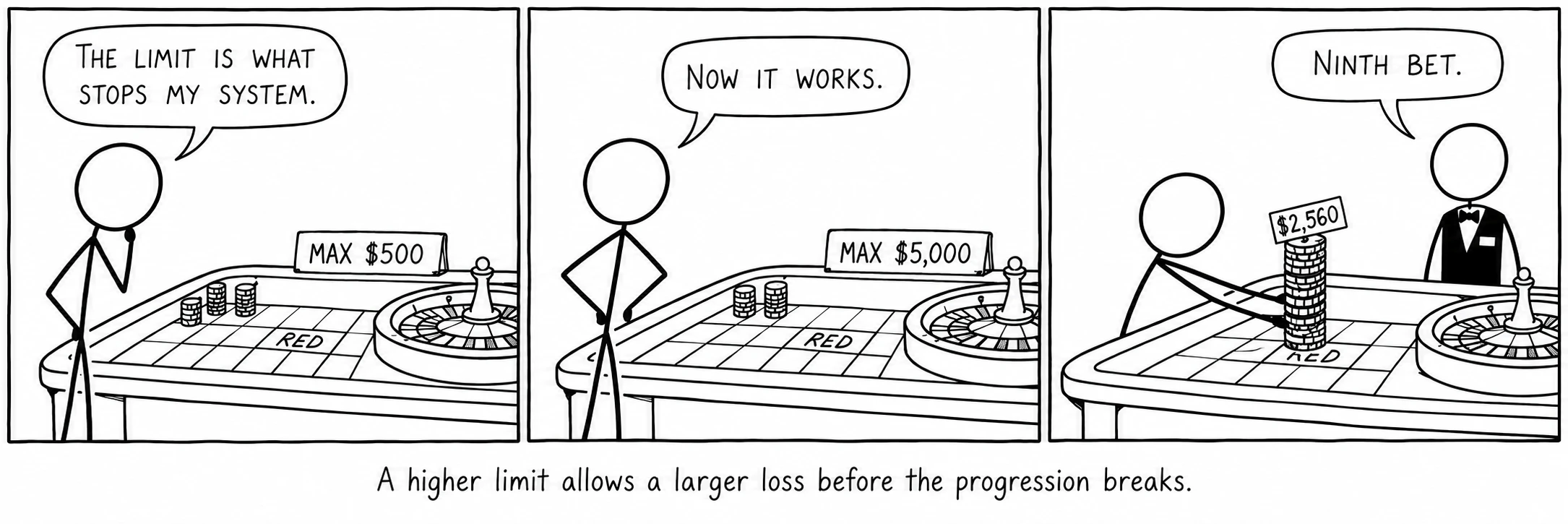
Manmano ken dakdakkel, iti tunggal limitasion. Saan nga agbaliw ti produkto.
Dagiti Taudan
- Ethier, S. N. The Doctrine of Chances: Probabilistic Aspects of Gambling.
- Thorp, E. O. “Optimal gambling systems for favorable games.”
- Thorp, E. O. The Mathematics of Gambling.
- Epstein, R. A. The Theory of Gambling and Statistical Logic, 2nd ed.